Why Your CV Gets Ignored in the First 30 Seconds: 7 Fixes That Improve Response Rates
Recruiters scan CVs in 7 seconds. Here are 7 evidence-backed fixes to survive the first 30 seconds and improve your interview response rate.
On this page
You've sent 50 applications. Maybe 100. You're qualified. You know you can do the job.
And yet: silence.
Not even a rejection. Just nothing.
You're not imagining it. One field experiment tracking over 90 job applications found candidates received no response at all in roughly 82% of cases9. That's not bad luck. That's the system working exactly as designed.
The problem isn't you. It's a mismatch between how you present yourself and how modern recruitment actually works.
01What this problem really is
Recruiters don't read CVs. They scan them.
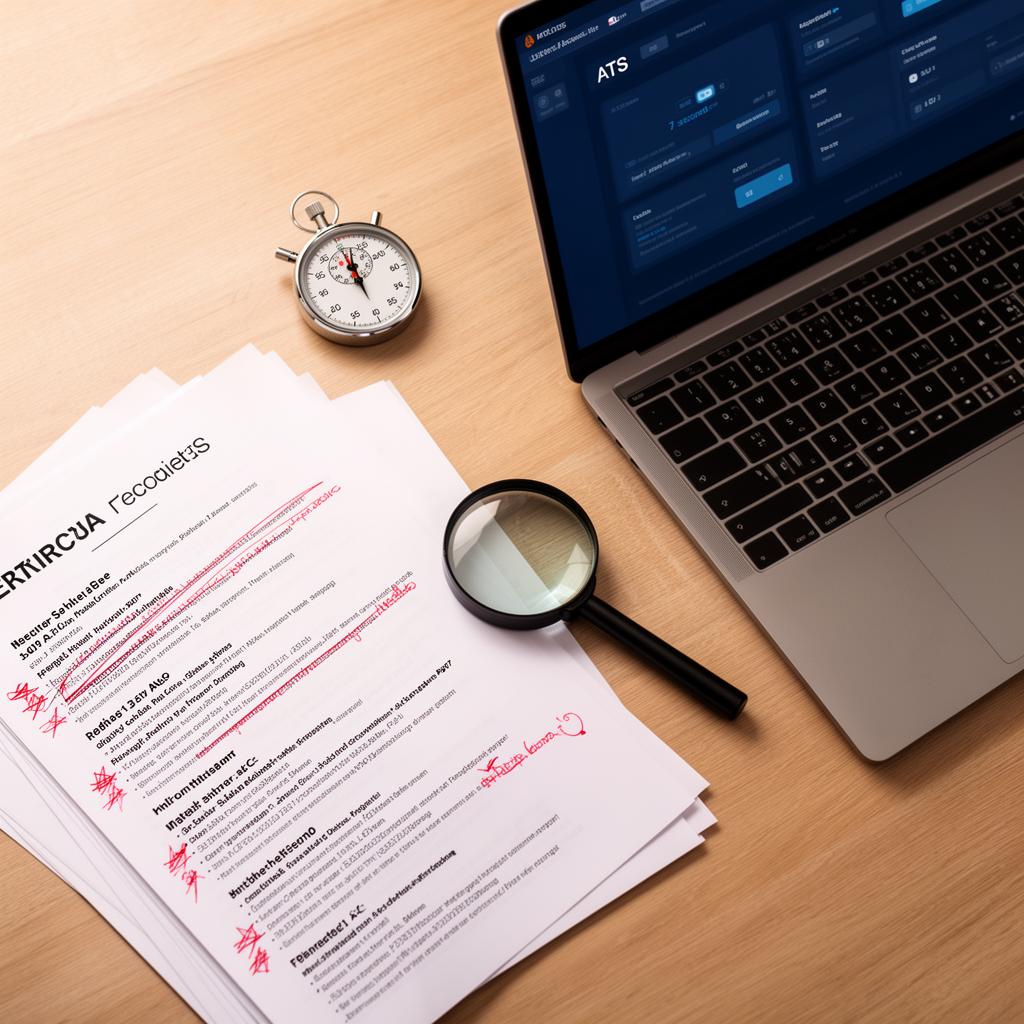
Eye-tracking research shows recruiters form an initial impression of a CV in about 7.4 seconds30. They focus on the top third of the first page, job titles, your current role, and education. Everything else gets skimmed or ignored entirely28.
That's not laziness. It's survival.
UK payrolled employee numbers fell by over 100,000 between March 2025 and March 2026, while unemployment sat at around 5.2%7. More candidates. Fewer roles. Every advertised position now attracts floods of applications, especially remote roles, which receive more than twice the applications of equivalent in-person jobs9.
Employers responded by leaning hard on Applicant Tracking Systems. Around 98% of Fortune 500 companies use some form of ATS3. These systems parse, score, and rank your CV before a human ever sees it.
Your CV isn't being rejected by a person. It's being buried by an algorithm.
02Why it happens
Seven things consistently kill CVs in those first 30 seconds.
1. Basic errors signal carelessness.
Around 77% of hiring managers view typos or grammatical mistakes as a deal-breaker4. A majority say they'd reject a candidate on spelling alone22. Your CV is a work sample. Errors suggest the work will have errors too.
2. Formatting confuses both humans and machines.
Cluttered layouts, unusual fonts, multiple columns, and heavy use of tables make it harder to find key information16. They also break ATS parsing, causing skills to vanish or work history to scramble3. Recruiters scanning in seconds don't fight through visual noise. They move on.
3. No tailoring means no relevance.
More than half of applicants don't customise their CV for the specific job description22. ATS systems filter and rank based on keywords drawn directly from the job posting3. A generic CV might be perfectly fine in isolation. But if it doesn't mirror the language of the role, it's effectively invisible.
4. Duties instead of achievements.
"Responsible for customer service" tells a recruiter nothing about what you actually delivered. Employers want evidence of measurable impact17. Without it, you look identical to every other applicant who held the same title.
5. Weak top-of-page impact.
Recruiters' eyes go straight to the top third28. If your name, current role, and recent experience don't immediately signal relevance, they won't scroll down to find out more.
6. ATS-unfriendly design.
Text boxes, graphics, images, and elaborate tables can cause ATS parsers to misread or drop content entirely3. Your carefully crafted skills section might not even make it into the database.
7. Over-reliance on online applications.
Candidates sourced by recruiters or referred by employees have significantly higher offer rates than those who simply apply online9. A well-optimised CV still struggles against candidates who have someone advocating for them internally.
03How it affects job seekers
The silence is brutal.
Nearly half of job seekers report losing confidence after around five rejections19. Except most of the time, there's no rejection at all. Just a void.
Application response rates have declined significantly since 2021. Candidates are now several times less likely to hear back than four years ago9. Average positive response rates on some channels sit in single digits.
This isn't a feedback loop. It's a black hole.
And it creates a vicious cycle. Repeated silence erodes confidence, which reduces the quality of subsequent applications, which leads to more silence19. Meanwhile, job seekers often can't tell whether the problem is their CV, their targeting, the market, or all three.
For experienced candidates, it gets worse. Research shows that age cues, career gaps, and long tenure can all trigger bias, even when qualifications are strong41. Mothers face lower perceived competence and reduced hiring probabilities compared with non-mothers21. These penalties operate silently. You'll never know they were the reason.
04What to do instead
These seven fixes address the seven failure modes. None require rewriting your CV from scratch.
1. Eliminate every error.
Read your CV out loud. Use a spell checker. Then have someone else read it. Around 81% of CVs contain at least some spelling or grammar issues22. Don't be one of them.
2. Simplify your formatting.
Single column. Standard fonts (Arial, Calibri, or similar) at 10-12 point3. Clear section headings. No text boxes, graphics, tables, or rating bars16. Save as .docx or a clean text-based PDF unless told otherwise. Test by saving as plain text to check nothing gets jumbled3.
3. Tailor every application.
Copy the job description into a keyword tool or simply read it carefully. Identify the skills, technologies, and qualifications mentioned most often. Ensure your CV uses the same language where it truthfully applies24. CVs with exact keyword matches are several times more likely to be shortlisted24.
You don't need to rewrite everything. Keep a master CV. For each application, adjust your summary, reorder sections to prioritise relevant experience, and edit a few bullet points to emphasise what matters most for that role4.
4. Convert duties into quantified achievements.
Instead of "managed a team", write "led an eight-person team to increase client retention by 23% within six months"17.
Ask yourself: How many? How much? How often? What changed? Even approximate figures work, provided they're honest and you can discuss them in an interview17.
5. Make the top third do the work.
Your summary should be 15-40 words22. No clichés. State your role, your key strengths for this specific job, and ideally one relevant achievement or domain. Reference the job title if you can. Recruiters will see this first. Make it count.
6. Address gaps and bias-prone signals.
If you have a career gap, account for it briefly. Frame it in terms of skills gained if possible14. For experienced candidates, consider focusing on the last 10-15 years and removing older graduation dates to reduce age-related assumptions41. Government guidance recommends listing experience in years rather than precise date ranges to reduce disadvantage associated with gaps14.
7. Build your LinkedIn profile and pursue referrals.
Candidates with comprehensive LinkedIn profiles receive interview callbacks at a rate roughly 71% higher than those without23. A bare-bones profile offers no benefit and may even hurt you23.
Networking isn't optional. Referred candidates make up a disproportionate share of hires9. If you're relying solely on online applications, you're fighting uphill.
05Common mistakes to avoid
Keyword stuffing.
Listing skills you don't actually have will backfire in interviews. Align truthfully with the job description, nothing more3.
Over-designed templates.
Those modern CVs with icons, columns, and skill bars look sharp. They also break ATS parsing and annoy recruiters16. Clean beats clever.
Burying key information.
Don't hide critical skills in dense paragraphs at the bottom of page two. ATS and recruiters both give most weight to the top of page one and the Skills section24.
Writing in third person.
"John is a results-oriented professional" is awkward and pretentious. Write in first person, minus the "I"22.
Using AI to write the whole thing.
Evidence suggests AI-generated CVs receive fewer callbacks than human-crafted ones6. Use AI for error checking and keyword identification. Keep the voice yours.
06A realistic example
Same job. Completely different impression.
Responsible for managing customer accounts and handling queries.
Managed 120+ client accounts across three sectors. Resolved an average of 45 queries per week with a 96% satisfaction rating, reducing escalations by 28% over six months.
The first tells the recruiter what you were supposed to do. The second tells them what happened because you did it.
07Key takeaway
Your CV isn't being ignored because you're not good enough.
It's being ignored because it doesn't survive the first 30 seconds of a system built for speed, not depth.
Fix the errors. Simplify the format. Tailor to the role. Quantify what you achieved. Front-load the relevance. Address the gaps. Build presence beyond the application.
None of this guarantees interviews. The market is tough, algorithms are opaque, and bias is real. But these changes shift the odds in your favour. Measurably.
Treat every application as an experiment. Track which versions get responses. Adjust. Repeat.
Rejection is information. Silence is data too.
08Frequently Asked Questions
How long do recruiters actually spend looking at a CV?
Will an ATS automatically reject my CV if the formatting is wrong?
Do I really need a LinkedIn profile?
09Sources
3 https://capd.mit.edu/resources/make-your-resume-ats-friendly/
4 https://www.jobsprout.ai/blog/resume-mistakes
6 https://www.peoplemanagement.co.uk/article/1942356/ai-agents-authenticity-2026-will-rewrite-recruitment
7 https://www.ons.gov.uk/employmentandlabourmarket/peopleinwork/employmentandemployeetypes/bulletins/uklabourmarket/may2026
9 https://uppl.ai/job-application-response-rate/
13 https://www.resumeadapter.com/ats-statistics
14 https://www.gov.uk/government/publications/reduce-unconscious-bias-in-cv-screening/reduce-unconscious-bias-in-cv-screening
16 https://www.cvpilots.co.uk/blogs/career-advice/cv-formatting-pitfalls
17 https://www.vmsolu.com/why-quantifiable-achievements-on-your-resume-matter/
19 https://www.joblist.com/trends/almost-half-of-job-seekers-lost-confidence-from-receiving-rejection-letters
21 https://pmc.ncbi.nlm.nih.gov/articles/PMC7614241/
22 https://flair.hr/en/blog/resume-statistics/
23 https://www.resumego.net/research/linkedin-interview-chances/
24 https://resumeworded.com/targeted-resume
28 https://www.bu.edu/com/files/2018/10/TheLadders-EyeTracking-StudyC2.pdf
30 https://www.hrdive.com/news/eye-tracking-study-shows-recruiters-look-at-resumes-for-7-seconds/541582/
41 https://www.nysscpa.org/article-content/survey-more-than-one-third-of-hiring-managers-avoid-older-and-younger-job-candidates-040524
Try CVBlocks
Build an ATS-ready CV in minutes
CVBlocks generates role-specific text blocks you can paste straight into Word or Canva. No sign-up.
Build my CV content →