How to Tailor Your CV for Each Job Without Starting From Scratch
Learn how to tailor your CV for each job in 20 minutes using a master template method. Practical steps to beat ATS and impress recruiters.
On this page
More than half of job seekers send the same CV to every role18. The other half wish they did, because tailoring feels like rewriting a dissertation every time.

Here is the problem. Employers say generic CVs are one of their biggest obstacles to finding good candidates15. They want applications that speak directly to the role. But they also receive around 43 applications per vacancy on average, and in some sectors that number climbs past 10024.
You cannot win by sending the same document everywhere. You also cannot win by burning out after three bespoke applications.
The answer is not to work harder. It is to work on the right 15% of your CV and leave the rest alone.
01What this problem really is
Tailoring does not mean rewriting. Most people hear "customise your CV" and picture starting with a blank page. That is not what recruiters want. They want evidence that you read the job advert and can connect your experience to their specific needs.
The real problem is inefficiency. Candidates either skip tailoring entirely or spend hours on changes that do not move the needle. Both approaches fail.
Recruiters spend about two thirds of their review time on your work experience section2. They form first impressions in seconds, but contrary to the famous "six second" myth, recent research shows average review times closer to 17 to 46 seconds depending on CV length11. That is enough time to notice whether your CV speaks to the role. It is not enough time to forgive a mismatch.
ATS (applicant tracking systems) add another layer. Around 80% of CVs now pass through some form of ATS screening7. These systems parse your document, extract data, and compare it against the job description. A CV with weak keyword alignment gets ranked low, which means a recruiter may never scroll down to see it10.
The widely quoted claim that 75% of CVs are rejected by ATS before a human sees them? That figure has no solid empirical backing10. But ATS can absolutely bury good candidates when formatting confuses the parser or key terms are missing from obvious places.
02Why it happens
Three forces collide to make tailoring feel impossible.
Time pressure.
Career guidance suggests serious job seekers may need 20 to 30 hours per week on job search activities, including researching roles and tailoring documents20. Most people cannot come close to that. When you are told to submit 10 to 15 applications per week while modifying each CV and cover letter, the maths stops working20.
Conflicting advice.
Some sources insist on a one page CV. Others say two pages are preferred for experienced professionals. Surveys of professional CV writers show that two page documents are often favoured for mid-career candidates, and word counts between 475 and 600 words correlate with the highest interview rates219. Meanwhile, candidates hear they must "mirror the job description" without being told which parts to mirror, or how.
Emotional drain.
Around 86% of job seekers report burnout associated with crafting applications45. Rejection without feedback compounds the problem. You send out CVs, hear nothing, and have no idea what to fix.
The result? People either give up on tailoring or approach it chaotically, changing random sections without a clear method.
03How it affects job seekers
Generic CVs fail in two places.
At the ATS stage.
If your CV does not include the right keywords in the right sections, it ranks lower. Recruiters working through a stack of 50 applications will not dig deep to find buried qualifications. They will move on.
At the human stage.
Employers explicitly say that "generic CVs and cover letters that don't highlight unique strengths" and "lack of tailored or role-specific skills" make it harder to identify top applicants15. When every other CV looks the same, the one that directly addresses the job description stands out.
The candidates who do get interviews are typically those whose CVs meet at least half of the job's listed requirements and use the same language as the advert to describe relevant skills2. That is not about having more experience. It is about surfacing the experience you have in a way that matches what the employer asked for.
For career changers, returners, or anyone with a non-linear path, the stakes are higher. Research shows decision-makers often penalise applicants with career gaps, even when those breaks have legitimate explanations22. A tailored CV that clearly frames transferable skills and addresses gaps proactively can offset some of that bias.
04What to do instead
Stop rewriting. Start reconfiguring.
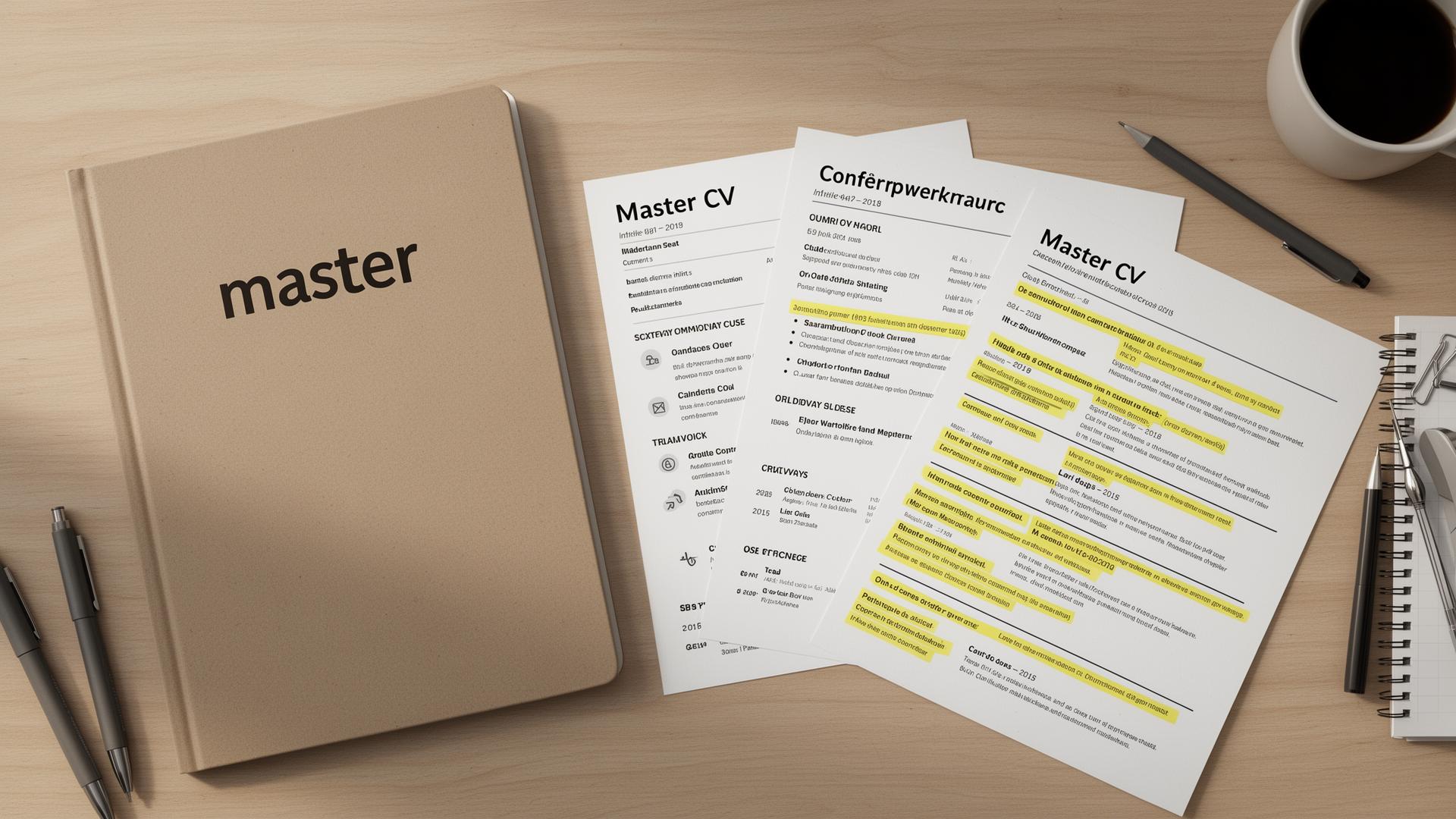
1. Build a master CV once.
This is a private document you never send to anyone. It contains every role you have held, every skill you have developed, every achievement you can remember. Include quantified results wherever possible. This becomes your source material.
University career guidance and professional bodies recommend maintaining a master CV from which you generate shorter, tailored versions by reordering and selectively emphasising content1244.
2. Create two or three base versions.
If you are applying to different types of roles, create a base CV for each type. A "project manager" base and a "business analyst" base, for example. Each base version has a role-specific profile, a curated skills section, and experience ordered to highlight relevance to that role type.
This cuts the tailoring time for each application because you are starting from something already 80% aligned.
3. Analyse job descriptions systematically.
Collect three to five job adverts for your target role type. Highlight every skill, tool, certification, and behavioural competency mentioned. Note which terms appear repeatedly. Keywords showing up in 80% or more of postings are high-priority industry-standard terms. Those in 40 to 60% are nice-to-have. Anything rarer is niche or company-specific7.
4. Map keywords to your actual experience.
For each high-priority keyword, write down a specific example from your past where you demonstrated that skill. If you cannot find an example, you have a genuine gap. Be honest about it. Claiming skills you do not have will surface in interviews717.
5. Tailor four zones for each application.
This is the 20-minute routine. Adjust only these sections:
- Profile (3-4 sentences at the top). Rewrite it for each role. Reference the specific job title, the most relevant skills, and one standout achievement that matches what the employer wants. Career advice describes this as a focused pitch that answers "why should this employer keep reading?"37.
- Skills section. Reorder and curate. Put the skills mentioned in the job advert at the top. Remove or demote anything irrelevant to this specific role. Use the employer's exact phrasing where it matches your real experience727.
- Most recent experience (first 2-3 roles). Adjust the first bullet point under each role to echo a key responsibility from the job description. Integrate keywords naturally into achievement statements. Recruiters spend most of their review time here2.
- Selected achievements. If the job advert emphasises cost reduction and you have a cost reduction achievement buried in an older role, pull it up or add it to a more prominent position.
6. Run a quick ATS check.
Use a free CV scanner to compare your tailored version against the job description. These tools flag missing keywords and structural issues17. Fix obvious gaps before submitting.
7. Proofread once more.
Almost 80% of CVs are rejected for spelling mistakes, poor grammar, or typos2. One in four are discarded due to poor design2. A final read catches errors that undermine everything else.
05Common mistakes to avoid
Keyword stuffing.
Copying long skill lists or entire phrases from the job advert without integrating them into your experience looks robotic. It may trick ATS briefly but fails with human reviewers.
Over-tailoring.
Rewriting your entire history for each role wastes time and creates inconsistency. Employers expect your core story to remain stable. The emphasis shifts, not the facts.
Relying on AI to write for you.
Around 80% of hiring managers view AI-generated CV text negatively13. Use tools for analysis and diagnostics. Keep the writing human.
Ignoring the job advert's priorities.
If a job description lists five requirements and three of them appear in the first paragraph, those three matter most. Do not treat all requirements equally.
Skipping the profile.
Some candidates leave the professional summary generic because rewriting it feels tedious. But this section sits at the top of the first page, where both ATS and recruiters look first. A tailored profile is high return for low effort.
06A realistic example
The job advert is for a Marketing Data Analyst. It emphasises SEO performance analysis, A/B testing, ecommerce experience, and cross-functional collaboration.
Experienced marketing professional with strong analytical skills and a passion for data-driven decision making.
Marketing data analyst with three years in ecommerce, specialising in SEO performance analysis and A/B testing. Led cross-functional reporting projects that increased campaign conversion rates by 22%.
The second version takes two minutes longer to write. It includes four keywords from the job advert and one quantified achievement directly relevant to the role.
In the skills section, the generic CV lists "data analysis, Excel, marketing strategy, teamwork." The tailored version leads with "SEO performance analysis, A/B testing, Google Analytics, cross-functional collaboration" because those are what the advert asked for.
Responsible for marketing analytics.
Built weekly SEO dashboards tracking organic traffic and conversion rates for a £2M ecommerce brand.
Same career. Same experience. Different signal.
07Key takeaway
Tailoring is not about rewriting. It is about selecting and positioning.
Build your materials once. Then spend 20 minutes per application adjusting the profile, skills, recent experience, and a few key achievements. Use the employer's language where it honestly describes your experience. Leave the rest alone.
Generic CVs disappear into the pile. Tailored CVs answer the question recruiters are actually asking: can this person do this job?
08Frequently Asked Questions
Do I really need to tailor if I already meet all the requirements?
How do I tailor when I am changing careers and my past job titles do not match?
Will tailoring for ATS make my CV sound robotic to human readers?
Try CVBlocks
Build an ATS-ready CV in minutes
CVBlocks generates role-specific text blocks you can paste straight into Word or Canva. No sign-up.
Build my CV content →