The Silence Trap: Why Interview Pauses Feel Disastrous but Often Help Interviewers Decide
Interview silence feels like rejection but usually means thinking or note-taking. Learn why pauses happen and how to handle them without spiralling.
On this page
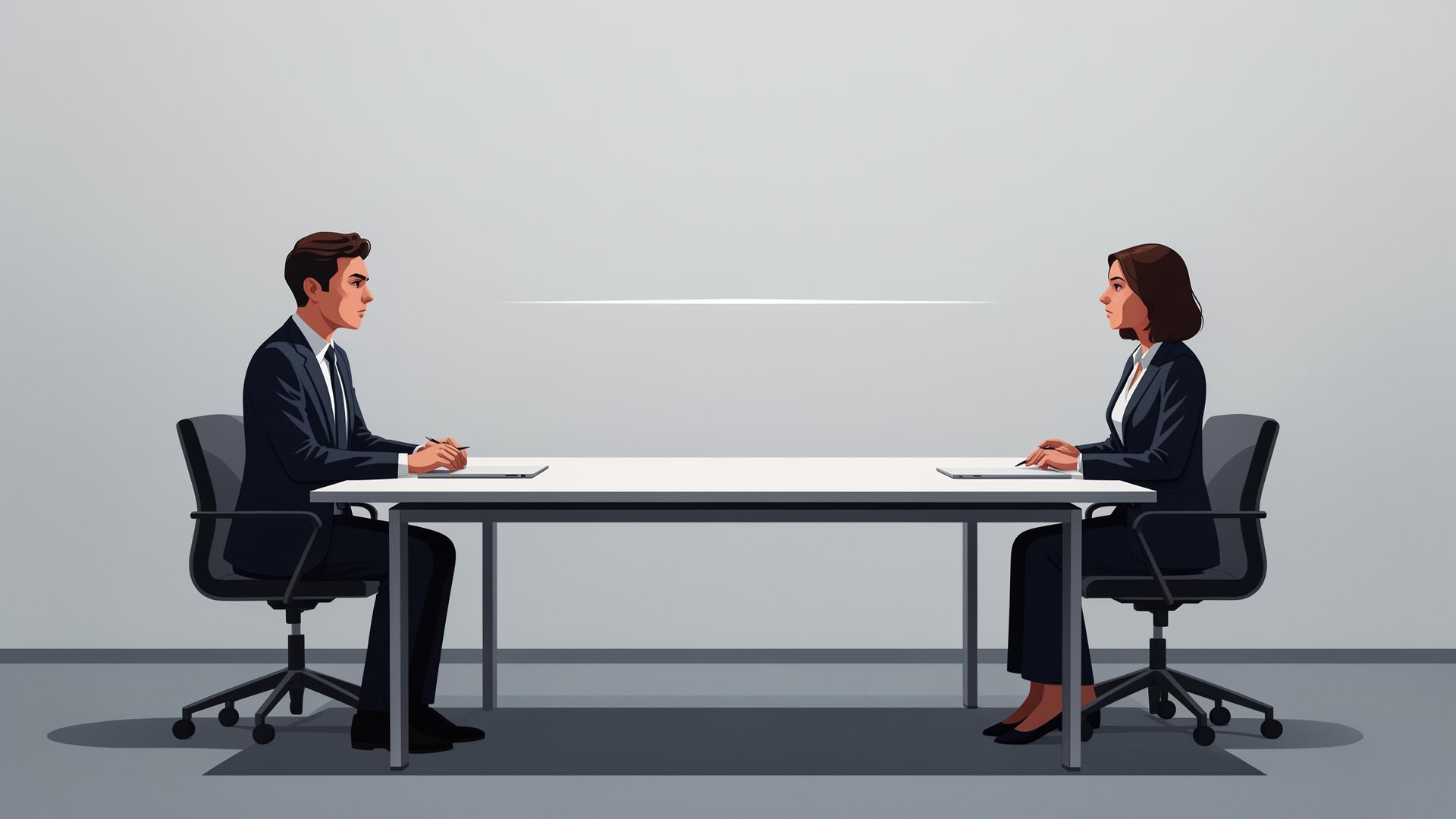
You finish your answer. The interviewer says nothing.
Two seconds pass. Three. Four. Your brain starts screaming. Did I say something wrong? Was that too long? Too short? Should I add more?
Here's what's actually happening: the interviewer is probably writing. Or thinking. Or waiting to see if you'll add something useful. Research on conversation suggests humans start feeling uncomfortable after just four seconds of silence, especially with strangers1. Job interviews are conversations with strangers where your income is at stake. No wonder that pause feels like a verdict.
It isn't.
01What this problem really is
The silence trap is a mismatch between what you feel and what's actually going on. You experience a pause as rejection. The interviewer experiences it as doing their job.
A survey of over 1,000 employed adults found 92% fear at least one aspect of job interviews28. The most common fear? Being too nervous. Silence amplifies every one of those fears because it offers no reassurance. No nod. No "that's interesting." Just quiet.
Meanwhile, interviewers using structured formats are trained to ask open questions, let candidates respond fully, then pause to take notes before moving on9. That silence you're catastrophising about is often just someone writing down what you said so they can score it fairly later.
The problem isn't that interviewers are becoming colder. It's that candidates and interviewers are reading the same moment completely differently.
02Why it happens
Your brain is wired to hate silence with strangers. Studies comparing conversations between friends and strangers found that long pauses felt significantly more awkward and negative between people who didn't know each other8. Interviews are stranger conversations with a power imbalance. Perfect conditions for discomfort.
Stress makes it worse. When you're anxious, time stretches. What's actually a three-second pause feels endless. Research on time perception shows that intense emotions, particularly fear and threat, activate brain regions that make external events feel slowed down40. You're not imagining that the silence lasted forever. Your brain is distorting it.
And there's the rejection piece. Humans tend to equate silence with disconnection1. If someone isn't responding, something must be wrong. In everyday life, that instinct is sometimes right. In an interview, it's usually misleading. The interviewer isn't withdrawing. They're processing.
Interview anxiety also predicts lower performance ratings, even when it doesn't reflect how well someone would actually do the job19. Anxiety functions as a filter at the selection stage. It makes people appear less competent than they are.
03How it affects job seekers
Silence triggers three common responses. None of them help.
First: rambling. You fill the gap with more words. You add examples, context, caveats. The structure of your answer dissolves. Interviewers end up with a wall of information and no clear takeaway6. Behavioural interviews rely on you being concise. Rambling makes it harder for them to score you.
Second: backtracking. You assume your answer was wrong and start revising it mid-stream. Now you've undermined your own point. You've also signalled uncertainty instead of confidence.
Third: withdrawing. You go quiet, avoid eye contact, shrink. Research shows that anxious nonverbal behaviour, things like fidgeting and tense body language, significantly lowers interview ratings13. Observers rated candidates with high anxious body language at roughly 3.5 out of 5, compared to just over 4 for calmer-seeming candidates13. The difference wasn't about what they said. It was how they looked while saying it.
One study found that interviewers' negative ratings of anxious candidates were driven mainly by perceptions of low warmth and low assertiveness, not specific nervous tics24. What matters isn't whether you fidget. It's whether you seem engaged and confident overall.
The vicious cycle looks like this: anxiety leads to poor performance, which increases sensitivity to silence, which fuels more anxiety. Each pause becomes evidence that you're failing.
04What to do instead
1. Pause before you answer
Count to three or four in your head before speaking. This gives you time to identify your main point. Research on consulting interviews suggests candidates who take a deliberate pause come across as more confident and thoughtful4. What feels like an eternity to you is a normal beat to the interviewer.
2. Use a structure
The STAR format (Situation, Task, Action, Result) or CAR (Context, Action, Result) forces you to be concise17. It also creates natural stopping points. You describe the situation. Pause. Describe your action. Pause. Give the result. Stop. If the interviewer wants more, they'll ask.
3. Sit in the silence
When the interviewer goes quiet after your answer, don't rush to fill it. Wait two to three seconds. Maintain eye contact. Keep your posture open. Interviewers often pause deliberately to see if you'll add something useful22. If you've made your point, let the silence breathe.
4. Reframe what silence means
Remind yourself that the interviewer is probably writing, thinking, or checking their rubric9. Structured interviews require note-taking. That's a sign they're taking your answers seriously, not that they're judging you.
5. Use water strategically
Ask for a glass of water at the start. When you need a moment before a tricky question, take a sip. It's a natural, socially acceptable pause that buys you time7.
6. Watch for clusters, not single cues
One pause doesn't mean anything. Repeated disengagement, combined with closed body language and evasive answers to your questions, might signal something. But isolated silences rarely do23.
05Common mistakes to avoid
- Interpreting every pause as a verdict. A single awkward silence is not evidence of failure. Interviewers have many reasons to pause. Most have nothing to do with your answer being wrong.
- Filling silence with filler. "So, yeah, I guess that's kind of what happened" undermines everything you just said. End on a clear point. Stop.
- Changing your answer because of a pause. If the interviewer wanted clarification, they'd ask. Revising unprompted makes you seem unsure of your own experience.
- Over-monitoring your body language. Research suggests that minor tics matter less than your overall impression of warmth and assertiveness24. Obsessing over whether you're fidgeting too much distracts you from being present.
- Assuming post-interview silence means rejection. Delays happen for many reasons: internal processes, reference checks, competing candidates, someone being on leave21. Silence after the interview often says more about the organisation's process maturity than about you.
06A realistic example
You're asked to describe a time you handled a difficult stakeholder. You use STAR. Situation: a project sponsor who kept changing requirements. Task: keep the project on track while maintaining the relationship. Action: scheduled weekly check-ins, documented decisions in writing, flagged risks early. Result: project delivered on time, sponsor gave positive feedback.
You stop. The interviewer looks down and writes.
Five seconds pass. Your brain says: they hated it. You want to add more.
You don't. You wait. You keep your posture open.
After eight seconds, the interviewer looks up and says, "Can you tell me more about how you flagged those risks?"
That's not a challenge. That's a probe. They want depth. You give it. The silence wasn't a sign of doubt. It was them doing their job properly.
07Key takeaway
Silence feels like rejection because your brain is built to interpret it that way. In interviews, that instinct is usually wrong. Most pauses mean thinking, writing, or probing. Not disapproval.
The candidates who handle silence well aren't the ones who never feel uncomfortable. They're the ones who've learned to sit in that discomfort without spiralling.
Pause before you speak. Structure your answers. Let the quiet happen. That's how you turn silence from a trap into a signal that you're composed under pressure.
08Frequently Asked Questions
Is it bad if my interviewer goes silent after I answer?
How long can I pause before answering without looking unprepared?
What should I do if I hear nothing after my interview?
09Sources
- 1 nngroup.com — Intentional silence in UX
- 4 careerlaunchpad.io — Pause before answering interview question
- 6 casebasix.com — Avoid rambling in behavioural interviews
- 7 live-recruitment.co.uk — How to stop talking too much in a job interview
- 8 pmc.ncbi.nlm.nih.gov — Conversation pauses between friends and strangers
- 9 jacobian.org — Interview notes
- 12 cambridge.org — Candidates' reactions to job application rejections
- 13 psypost.org — Anxious nonverbal behaviour harms job interview ratings
- 17 hr.berkeley.edu — Behavioural interview tips and examples
- 19 onlinelibrary.wiley.com — Interview anxiety and performance ratings
- 21 welcometothejungle.com — Silence from recruiter after job interview
- 22 interviewedge.com — Silence of the interviewer
- 23 ivyexec.com — Interviewers' body language
- 24 bps.org.uk — Why interviewers rate anxious candidates harshly
- 28 globenewswire.com — 92% of US adults fear something about job interviews
- 40 cipd.org — Health and wellbeing report 2025
Try CVBlocks
Build an ATS-ready CV in minutes
CVBlocks generates role-specific text blocks you can paste straight into Word or Canva. No sign-up.
Build my CV content →